F-POD software and user guidesThe free dedicated FPOD app displays, filters, analyses and exports the data. It uses the advanced KERNO-F classifier that pulls cetacean trains out of background noise.
Updates to the app are always compatible with earlier versions of both data and hardware and are also free.
The structure of F-POD data is open source, and for coders the source code that reads it and calculates some derivatives is available directly from the app. All the data logged is available to users plus the derived click train features generated by the KERNO-F classifier.
The free dedicated FPOD app displays, filters, analyses and exports the data. It uses the advanced KERNO-F classifier that pulls cetacean trains out of background noise.
Updates to the app are always compatible with earlier versions of both data and hardware and are also free.
The structure of F-POD data is open source, and for coders the source code that reads it and calculates some derivatives is available directly from the app. All the data logged is available to users plus the derived click train features generated by the KERNO-F classifier.
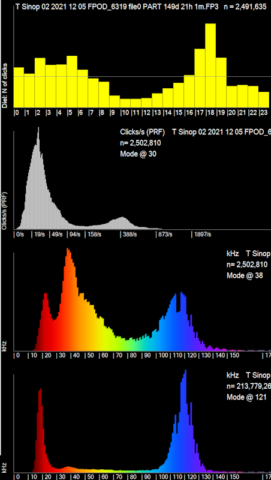
F-POD app
The current version of the FPOD app, dated 6th March 2026. It uses Version 1.0 of the advanced KERNO-F classifier.
The latest additions include an implementation of the PYRA method of estimating trends in detection rates / access to smoothed inter-click-interval values / file redaction for hiding time periods / an export utility for users who want to develop their own classifiers using machine learning or AI / and improved editing tools for marking trains or giving them type numbers, and fixing a data reading bug
Updated: 6th March 2026
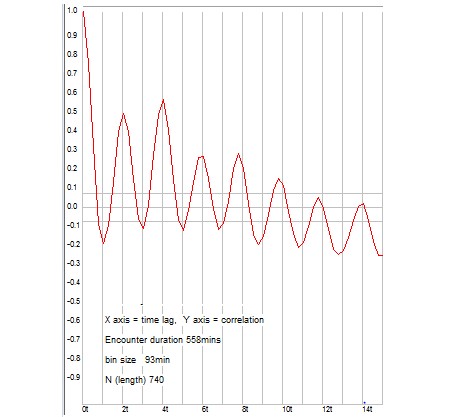
F-POD Software Guide
The F-POD app includes a lot of display, filtering and exporting options.
Hopefully this guide will be useful in learning your way round this beast!
Updated: August 2025
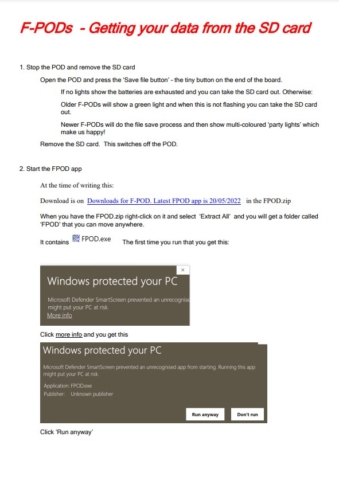
Getting your data from the SD card
Data on SD cards is in .CHE files, which may be one per day or other configurations, but in all cases you read them with the FPOD app and they are then on the PC as .FP1 files.
Mac users will need a PC-emulator
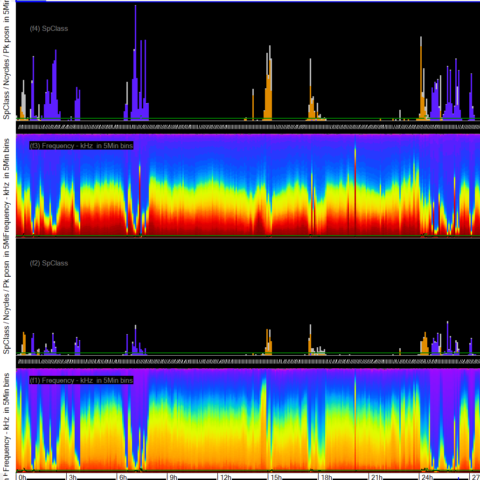
Samples of C-POD and F-POD data
Franciscana and Guiana dolphins recorded by Renan Paitach using a C-POD and an F-POD in Babitonga Bay in Brazil.
View these together in the FPOD app to see the differences between the instruments and species.
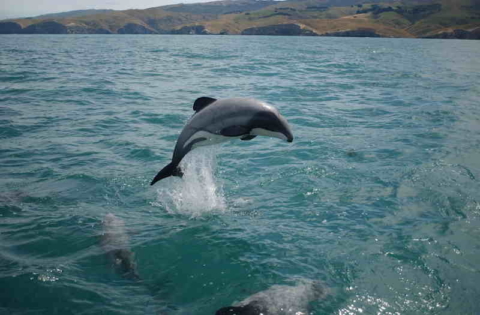
POD sightings template for use with F-POD app
Excel template for adding annotations to F-POD and C-POD files.
If you make observations, or arrive at species classifications using your own classifier, you can rapidly add your findings to the file so that the app will show your species designation on a minute by minute basis. Then you can filter the data by the species information you added.
Updated: July 2024
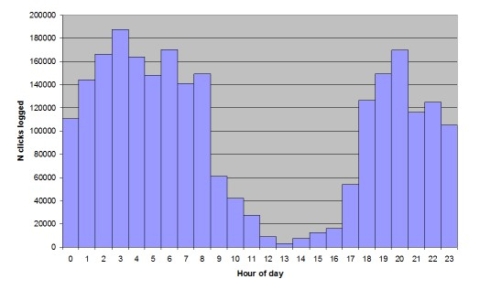
Exporting data into Microsoft Access, running queries and creating charts.
Databases can be quicker and easier to use for large data sets such as those from POD studies.
This is a brief guide to using queries in Microsoft’s Access.
F-POD app version history
This is a reference document on software changes and is of limited interest!
The KERNO-F classifier that underpins the usefulness of F-PODs is based on deep ‘feature engineering’ to seek ‘coherent’ click trains and then allocates them to species guilds or leaves then ‘unclassed’.
This takes you to a paper on the validation of the results.
This takes you to a paper on PYRA.
Updated: December 2024
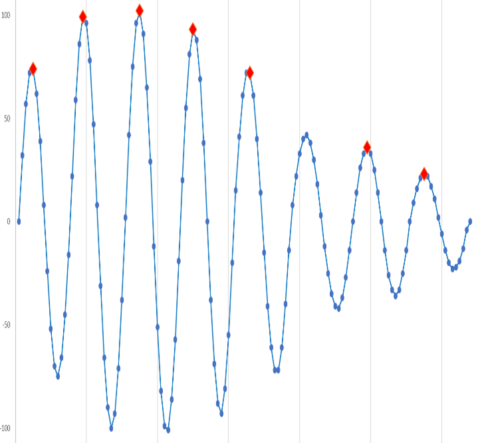
Data for developers
An interface now exists to allow you to extract detailed click, train and encounter features that you can use to develop AI or other classifiers.
Then you can inject your classification back into the FP3 file and see exactly how well it did!
Video guides on YouTube
The F-POD app
An overview of the F-POD desktop software application
Updated: November 2024
Opening F-POD data files
A good place to start.
Updated: November 2024
First look at an F-POD file
Viewing the data file as a whole
Updated: November 2024
More user guides:
Useful Videos, Guides and Reference documents
| Links to Guides,Videos and reference documents | Description | Updated |
|---|---|---|
| ~~~~~~~~~~~~~~~~~~~~~~~~~~~~~~~~ | ~~ ~ F-POD | |
| YouTube - Chelonia videos | YouTube resources | |
| ~~~~~~~~~~~~~~~~~~~~~~~~~~~~~~~~ | ~~ ~ Long tutorials | |
| F-POD software basics | Video tutorial: F-POD software basics 2h | 2023 |
| Data Validation | Video tutorial: F-POD data validaton - a key skill. 1.3h | 2023 |
| Data Export | Video tutorial: F-POD data exporting 1.3h | 2023 |
| Understanding Click Trains | Video tutorial: F-POD - In-depth look at click trains 1h | 2023 |
| Finding missed detections in POD data | Video tutorial: Finding missed detections in POD data. 30mins | 2025 |
| ~~~~~~~~~~~~~~~~~~~~~~~~~~~~~~~~ | ~~ ~ Hardware | |
| Warranty-September-2023 | PDF: F-POD warranty | 2023 |
| F-POD Hardware User Guides | Page: Hardware user guides on F-PODs, Acoustic release and more | 2025 |
| Essential guides to using F-POD Integrated Acoustic Release | Video tutorials: F-POD Integrated Acoustic Release | 2025 |
| Deck crew skills | PDF: Delegating POD handling to deck crews is a critical step - these are the minimum skills | 2024 |
| The Lithium battery pack | PDF: The Lithium battery pack | 2025 |
| ~~~~~~~~~~~~~~~~~~~~~~~~~~~~~~~~ | ~~ ~ Technical description | |
| F-POD Specification | Page: F-POD specification | 2025 |
| How the F-POD works | PPT: The acoustic design and the KERNO-F classifier | 2024 |
| F-POD technical description | PDF: F-POD published technical description for reference | 2023 |
| ~~~~~~~~~~~~~~~~~~~~~~~~~~~~~~~~ | ~~ ~ F-POD DATA | |
| Project Data Management | PowerPoint: Project data management | 2023 |
| F-POD reading the SD card | PDF: Gettings started: reading the SD card | 2024 |
| The scary F-POD app | Video: A quick tour of this box of speedy tools | 2024 |
| First look at an F-POD file | Video: First look at an F-POD file | 2024 |
| Running the KERNO-F classifier | Video: The KERNO-F classifier creates the FP3 files. Also describes updating FP3 files | 2024 |
| Opening a data file | Video: Opening F-POD and C-POD files | |
| Graphing POD data | Video: Graphs are fun - they give you a very fast analysis of whatever set of clicks are on show. | 2024 |
| The Array Viewer | Video: The array viewer can animate the detections across any spatial array of PODs | 2016 |
| Good click trains | Video: Features of trains from train sources. | 2024 |
| NBHF click trains | Video: Features of clicks from porpoises. | 2024 |
| Dolphin click trains | Video: Features of clicks from dolphins. | 2024 |
| Sonars | Video: Features of clicks from sonars. | 2024 |
| Multipath clusters | Video: Clicks are often logged as clusters of clicks ... the explanation is here | 2024 |
| Exporting detailed click data | Video: The unfamiliar world of high-resolution time-domain data. You saw it here first! | 2024 |
| Validating F-POD data | PDF: Validation of F-POD data - a key advanced skill | 2024 |
| File Cropping and Time selections | Video: Cropping is an essential step in handling data files | 2024 |
| Marking social click trains | Video: Click bursts are social communication and are a new world to explore! | 2024 |
| Exporting basic F-POD data | Video: Every aspect of your data and its classification can be exported! | 2024 |
| Exporting cetacean and environmental data | Video: Exporting Detections and Environment is a good starting point | 2024 |
| Spreadsheet for adding annotations | Spreadsheet: This is needed to add sightings or other annotations to a data file | 2021 |
| Exporting fish tag detections | Video: PODs log fish tags, but don't decode them | 2022 |
| Minute number errors | Doc: Microsoft and 'R' differ on the interpretation of date.time values!! | 2024 |
| ~~~~~~~~~~~~~~~~~~~~~~~~~~~~~~~~ | ~~ ~ Project reports | |
| The ECOMMAS cetacean study | PDF: A brief analysis of a ground-breaking project on coastal cetacean trends | 2023 |
| SAMBAH report | PDF: This is final report on this ground-breaking study of Baltic porpoises | 2017 |
| Trial of instruments for Vaquita monitoring | PDF: A NOAA Technical Memorandum on this field trial comparing instruments and methods | 2010 |
| ~~~~~~~~~~~~~~~~~~~~~~~~~~~~~~~~ | ~~ ~ Special Tools | |
| Read-only SD card problem | How to remove read-only status from an SD card | 2024 |
| Third-party Tools | PDF: You can now access an advanced feature set for your own research on classifiers | 2020 |
| PYRA | Paper: Estimating cetacean population trends from static acoustic monitoring data using Paired Year Ratio Assessment (PYRA) | 2021 |
| Comparing Instruments | PowerPoint: Comparing instruments has challenges that are often overlooked | 2022 |
| F-POD classifier independence | PowerPoint: The species classifiers in KERNO-F are not independent. This addresses some of the issues | 2024 |
| Auto-correlation | Video: Using the Autocorrelation function | |
| Using Access | PDF: Some notes on Microsoft Access queries on POD data | 2018 |