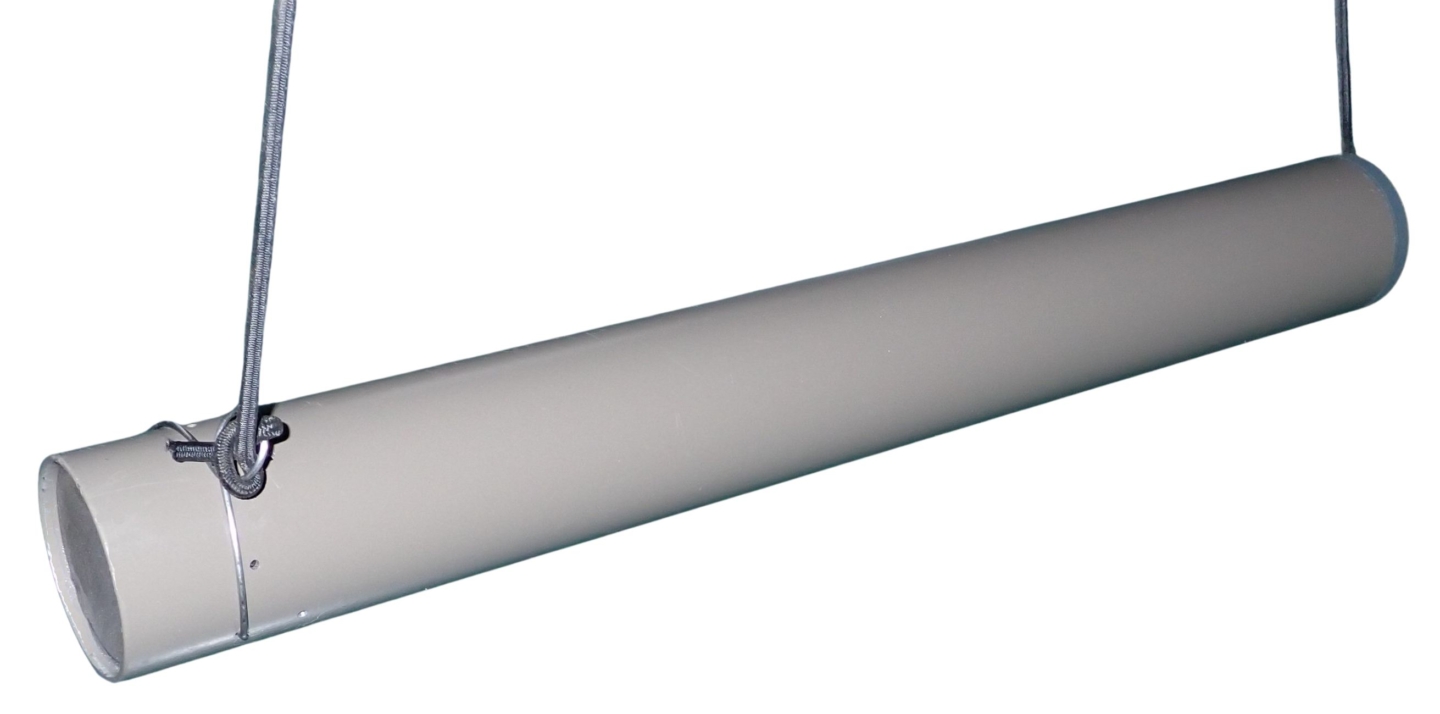
Design aims
The aim of the BatBug is:
To facilitate accurate long-term acoustic monitoring of bat populations, monitoring in remote locations, and low-carbon-cost monitoring.
To achieve this it aims to combine:
- flexible deployment options (e.g. using an extending pole as above)
- wide coverage of frequencies – 9kHz to 230kHz
- compact data so that 32GB will hold 1 year of very high precision data
- optional solar power to reduce servicing visits
- rapid automated analysis – this is partly developed and awaits more extensive training data
- low false positive rates reducing the need for human-in-the-loop analysis
- reliability – can run unattended for 1 year through all weathers
Compact data: the BatBug holds over one year of bat data on one 32GB SD card. The wavelength of every cycle in a bat call is logged to 250ns precision so very precise delineation of the frequency sweep in each call is possible. To achieve this very fast sound analysis is used to pick out only actual calls, plus any ambient sounds that resemble calls. This micro-triggering is carried out by a wavelet transform algorithm that triggers on short segments of sound that have a low bandwidth. Some sound from before and after any such tonal event is also logged.
Micro-triggering also reduces the complexity of the set up process, as it automatically finds the optimum threshold in quiet or noisy conditions so there is no need to adjust and detection settings to match some prediction of what will happen. Triggering is on bandwidth not frequency, so it works for bats of all frequencies. The bandwidth is measured over a short time window, not over the whole call.
Automated call detection is carried on in post-processing on a PC and is very fast – less than 1 minute per day of data – because of the computation that has already been done in the BatBug.
Environmental data: light and temperature are recorded each minute.
Waterproofing: the instrument can tolerate continuous heavy rain providing it is at least 30 degrees from facing vertically upwards. (A vertical view is possible if required by pointing a horizontal BatBug at a smooth flat surface sloping at 45 degrees).
Frequency range: 9kHz to 230kHz.
Directionality: The zone of sensitivity is a cone in the long axis of the BatBug and out to about 45 degrees from this.
Audio: The BatBug does not make any sound for you (or bats) to hear, but you can replay calls later from a PC giving remarkable audio detail.
Batteries/power: the Solar Powered BatBug runs indefinitely from a solar panel plus night battery unit.
Alternatively, the BatBug can use up to 3 internal stacks of 6 AA cells. Any type of AA cell can be used, with only one type in a stack. On NiMH AA rechargeable batteries it can typically run non-stop for more than 21 days. ‘Night only’ can be set using the light sensor to switch it on and off at a chosen light level. No times need to be picked and this greatly extends the number of nights that can be logged, especially in summer.
The aim of the BatBug is:
To facilitate accurate long-term acoustic monitoring of bat populations, monitoring in remote locations, and low-carbon-cost monitoring.
To achieve this it aims to combine:
- flexible deployment options (e.g. using an extending pole as above)
- wide coverage of frequencies – 9kHz to 230kHz
- compact data so that 32GB will hold 1 year of very high precision data
- optional solar power to reduce servicing visits
- rapid automated analysis – this is partly developed and awaits more extensive training data
- low false positive rates reducing the need for human-in-the-loop analysis
- reliability – can run unattended for 1 year through all weathers
Compact data: the BatBug holds over one year of bat data on one 32GB SD card. The wavelength of every cycle in a bat call is logged to 250ns precision so very precise delineation of the frequency sweep in each call is possible. To achieve this very fast sound analysis is used to pick out only actual calls, plus any ambient sounds that resemble calls. This micro-triggering is carried out by a wavelet transform algorithm that triggers on short segments of sound that have a low bandwidth. Some sound from before and after any such tonal event is also logged.
Micro-triggering also reduces the complexity of the set up process, as it automatically finds the optimum threshold in quiet or noisy conditions so there is no need to adjust and detection settings to match some prediction of what will happen. Triggering is on bandwidth not frequency, so it works for bats of all frequencies. The bandwidth is measured over a short time window, not over the whole call.
Automated call detection is carried on in post-processing on a PC and is very fast – less than 1 minute per day of data – because of the computation that has already been done in the BatBug.
Environmental data: light and temperature are recorded each minute.
Waterproofing: the instrument can tolerate continuous heavy rain providing it is at least 30 degrees from facing vertically upwards. (A vertical view is possible if required by pointing a horizontal BatBug at a smooth flat surface sloping at 45 degrees).
Frequency range: 9kHz to 230kHz.
Directionality: The zone of sensitivity is a cone in the long axis of the BatBug and out to about 45 degrees from this.
Audio: The BatBug does not make any sound for you (or bats) to hear, but you can replay calls later from a PC giving remarkable audio detail.
Batteries/power: the Solar Powered BatBug runs indefinitely from a solar panel plus night battery unit.
Alternatively, the BatBug can use up to 3 internal stacks of 6 AA cells. Any type of AA cell can be used, with only one type in a stack. On NiMH AA rechargeable batteries it can typically run non-stop for more than 21 days. ‘Night only’ can be set using the light sensor to switch it on and off at a chosen light level. No times need to be picked and this greatly extends the number of nights that can be logged, especially in summer.
Data streaming over the internet
The BatBug has two technical features that make it ideal for data streaming. These are:
Real-time bat call identification.
- This is achieved using a fast parallel-processing architecture, similar to that in the F-POD.
- This reduces the volume of data to be streamed per minute.
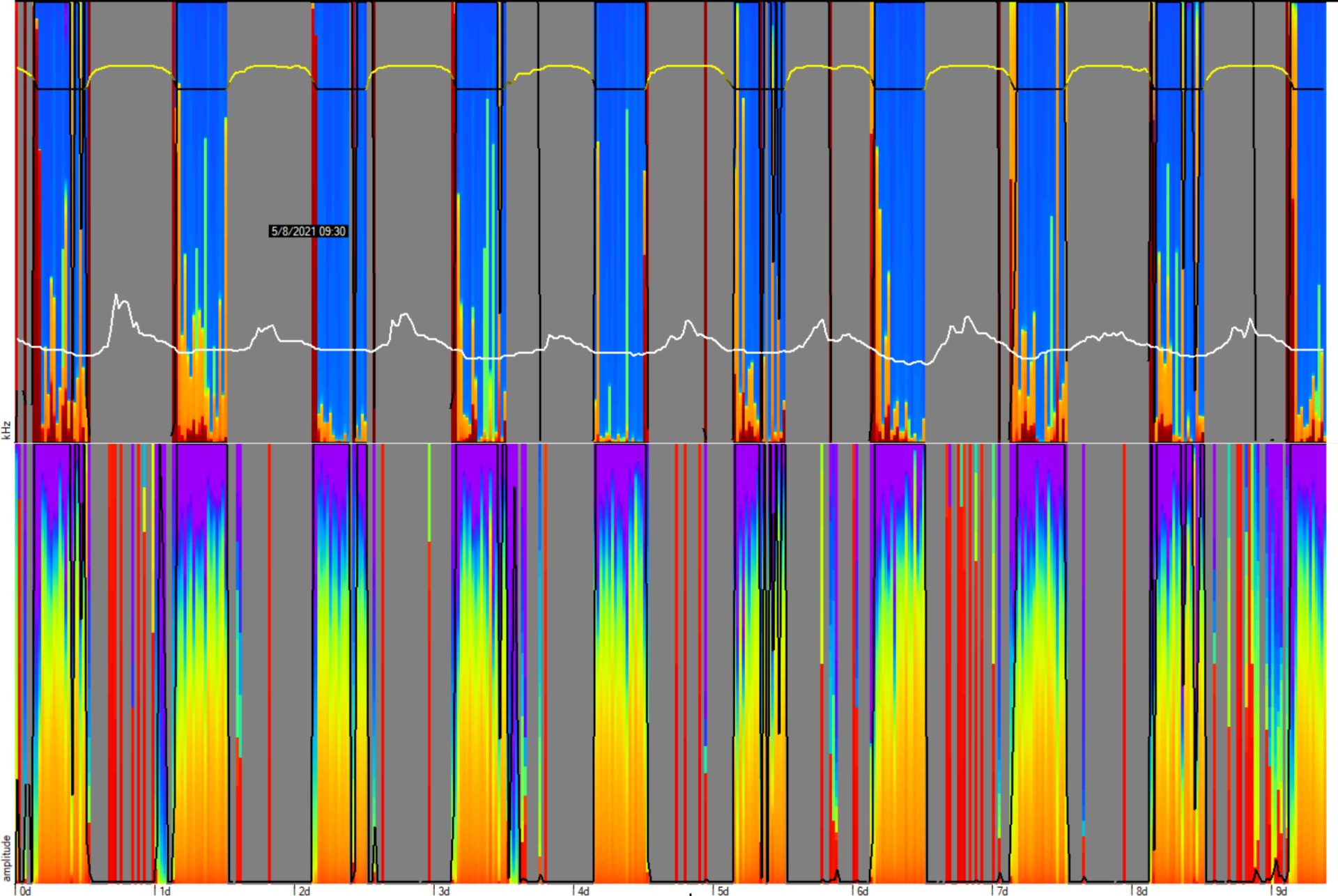
- The graphic shows, in the lower panel, the raw data that is stored over 10 days. During the day some cricket calls were stored
- The upper panel shows the complete bat calls found during post-processing
- Transmissions could include either all the raw data or only significant summary statistics generated in the BatBug if transmission bandwidth is very low
High resolution waveforms
- The high sampling rate (1MHz) and real time upsampling to 4MHz give high precision time-domain data
- The wave period of every cycle within a call is logged to 250ns precision
- This gives exceptional detail of the spectral trend within a call
- The volume of this data is much lower than in WAVE files, expecially for low pitched calls
Logging for 1 year, non-stop, on a 10W solar panel at a moderately used site gave 1.7million calls with a 32GB SD card being able to store 55 years of such recording.
This combination of high-precision data with very low volumes is ideal for data streaming over phone or other networks.