Summary
The Vaquita is the most-endangered marine mammal in the world with less than 20 animals remaining in the Upper Gulf of California. Vaquita is one of only 7 porpoise species and has shown a massive decline over recent decades due to incidental capture in gill nets.
PODs have had two other useful effects: they have shown where the animals spend most of their time which helps define protection zones, and by showing where the Vaquita have recently been they have enabled directed visual effort that can collect valuable photographs of identifiable individuals.
This video https://islandpress.org/videos/webinar-saving-vaquita gives a compelling account and deeply informative account of the conservation story up to late 2018. Since then a ‘zero-tolerance zone’ has been established and 193 net entangling devices have been installed and this has created a limited sanctuary with greater effectiveness than any previous measure. F-POD monitoring continues and shows some of limitations and potential improvements of this valuable development.
Research question
The Vaquita monitoring project sought to understand whether conservation measures were working, and therefore if the Vaquita population was increasing as a result?
Findings
The results showed a worsening decline and have triggered the difficult decision to try to capture the last few before they are lost to bycatch.

Project details
The vaquita is a species of porpoise found only in Mexican waters in the northern part of the Gulf of California. The Gulf is an acoustically difficult environment with noise from shrimps, sediment transport, common and bottlenose dolphins and weak unknown train sources.
A trial and power analysis of possible acoustic monitoring methods was made by Jay Barlow (NOAA) and Armando Jaramillo (CICESE) and the C-POD was selected on account of good sensitivity combined with low false positive rates and low project costs.
Instrument losses, mainly due to interaction with fisheries, created data gaps and modelling was used to refine the trend estimates. In this very critical application, all automated vaquita detections are visually validated by the Mexican research team. C-POD data demonstrates the ability of static acoustic monitoring to obtain such large numbers of detections that useful precision can be obtained even from very small populations.
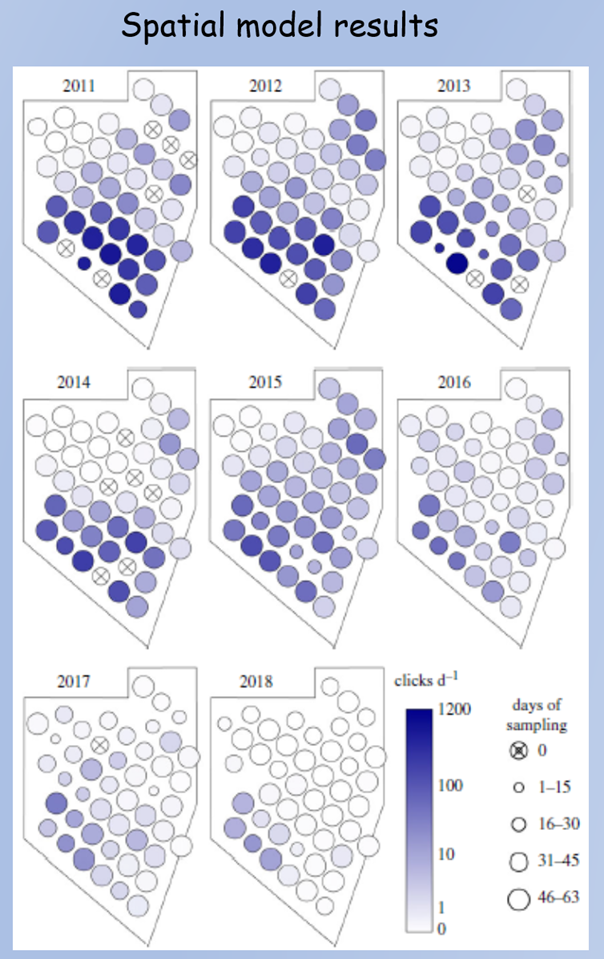
C-POD data from fixed sites
An array of about 50 C-PODs has been used to monitor the trend in the population and has been able to do this even when the population has fallen below 20. This very consistent data has been seriously valuable in showing that the problem has not been fixed. A detailed report is given in this paper https://royalsocietypublishing.org/doi/10.1098/rsos.190598
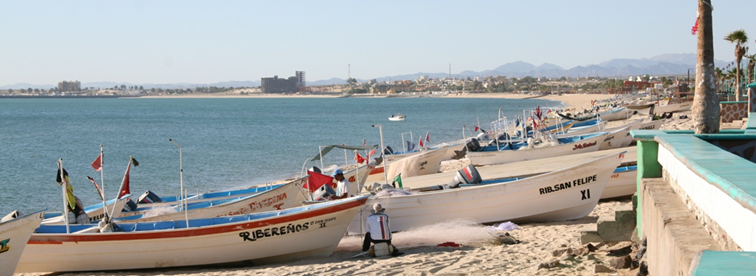
Gill net fishing boats, Upper Gulf of California.